
Armando Zavalza
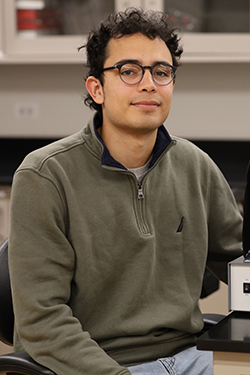
When Armando Zavalza applied to Triton College, he described the experience as almost serendipitous.
He already had a bachelor’s degree in natural resources and environmental sciences from a university and had been working toward a master’s in the same field before deciding to step away. Zavalza found himself at a crossroads, unsure of his next steps — try his luck in the job market or go back to school and start over.
“I almost pulled my hair out,” he said. “I was applying to jobs and getting nowhere, and I just felt that there had to be more for me somewhere.”
On a spur-of-the-moment decision, Zavalza chose to return to school and enroll at Triton just days before the start of the semester.
Now, he’s one of the institution’s inaugural students in its new Associate in Engineering Science, or AES, degree program and a recipient of the Department of Energy’s FORGE Grant, which provides Zavalza and other students in the program with full scholarships and a paid internship at Fermilab during the summer.
“As a recipient, it just feels like a blessing,” Zavalza said. “It’s like a second chance.”
This fall, Triton College launched its new Associate in Engineering Science degree, paving the way for students to earn their associate degree at Triton. The degree enables Triton College to join the University of Illinois Urbana-Champaign’s Grainger Engineering Pathway, guaranteeing admission for its students who successfully complete the program.
In addition to the streamlined transfer process to U. of I., courses in Triton’s AES program align with the requirements of other four-year universities across Illinois. One of the program’s most significant benefits is cost savings — students can save about $32,000 in their first two years by starting at Triton.
“This program is an affordable option for students to gain exposure to a wide range of engineering career paths,” said Dr. Farzan Ghauri, engineering and physics faculty member. “Triton College’s partnership with Fermilab is a unique asset, providing students with hands-on training and the opportunity to work at the cutting edge of physics and engineering.”
Ghauri said Triton’s program and community college model offer students a more personalized and intimate learning experience than they might find at a large university, where they would have to compete with more than 100 other students for a professor’s attention.
“I know each of my students,” Ghauri said. “I know every single mistake they make on their quizzes and exams, which allows me to evaluate where they need more understanding. There’s no way you’re going to get that foundational help at a large university where one class could have 150 students.
“When students complete this program, we’re not just ensuring that they get admission to a four-year school — we’re making sure they move forward with the reputation that, because they came from Triton, they know their stuff.”
Having experienced life at a large, four-year institution, Zavalza described the setting at Triton as being similar to graduate school.
“It feels like when I was working on my thesis,” he said. “It really encourages you to develop close relationships when you’re in a smaller class size, and you get so much more out of it.”
With the wind in his sails and a new course ahead, Zavalza said there’s less weight on his shoulders and he can finally catch his breath.
“I’ve been through the wringer, but now, being part of this program, I feel like Triton believes in me,” he said. “And why shouldn’t they? I know what I’m capable of. Now I get to prove myself.”
For more information about Triton College’s Associate in Engineering Science Degree, visit Triton.edu.